So You Want To Shoot at an XTDS event?
My current photos are too dark, should I use a Flash?
No.
Using flash at a dance event is ill-advised for quite a few reasons:
- Some dancers are hyper sensitive to a sudden bright source of light.
- It may distract the dancers.
- It will impact the white balance of other photographers (their pictures are suddenly more yellow).
- It will impact the exposure of other photographers (their pictures are suddenly significantly brighter and highlights are blown out).
- It will blind photographers sitting right in front of you.
Other than these reasons, using a flash encourages others to use flash too, which will make this problem worse on the long run.
What equipment do I need?
To take pictures at a sport event only two things are needed:
- a fast lens with maximum aperture lower or equal to f/2.8,
- a decent camera body.
While having multiple lenses has some advantages, one lens is usually enough to get good pictures. The most important detail here is that the lowest f-number on the lens is at most 2.8. Such lens let a lot of light entering the camera, avoiding going in high ISO settings. Note that most entry level cameras come wih a kit lens, for example RF-S 55-210mm f/5-7.1. Those are way too dark (large f-number) to be properly usable for indoor sport photography.
With regard to the body, having a responsive autofocus is important as you will be tracking fast moving subjects. Having a good FPS (ability to shoot a several pictures per second) helps in capturing the perfect moment, but it is not a must have. It is also a double-edged sword as you will have to go through significantly more pictures in the editing steps.
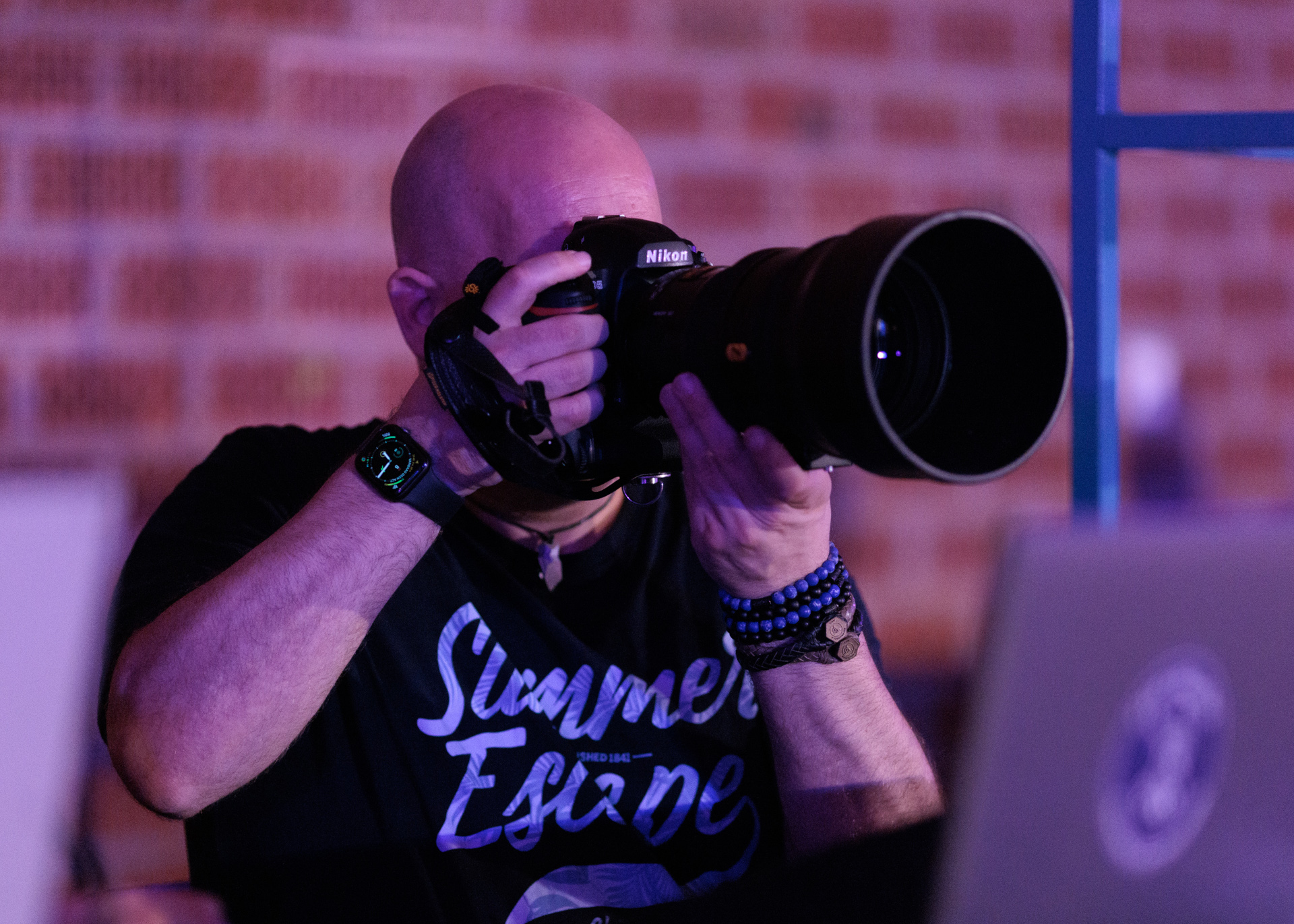
Marty and his famous Nikon 200mm f/2 VR lens.
If we can't use a flash, Doesn't this effectively limits the access to only people with more than 1000€ of equipment?
Not really.
The problem is that most people don't know what they really need when buying gear, and yes, the 70-200mm f/2.8 or 24-70mm f/2.8 are expensive lens and can easily cost more than 2000€ each. However, by making some compromises, it is possible to build a set under 1000€ which would allow to still get great pictures. In order to do so, we must forget about using zoom lenses and focus on primes. There are 3 lenses which will significantly lower the entry price:
- 50mm f/1.8
- 85mm f/1.8
- 135mm f/2
I strongly recommend the 50mm or 85mm if you already own a camera body with a crop sensor:
- Canon: 60D, 70D, 80D, 90D, 750D, 250D, 2000D, R7, R10, R50.
- Sony: a6000, a6300, a6400 etc.
- Nikon: D3500, D7500, Z30, Z50, ZFc etc.
If you do not alreay have a camera body, you should consider getting one second hand. You can find great deals by looking at old professional cameras such as a Canon 5D mk ii.
By combining a 5D mk ii (~300€), an EF 85mm f/1.8 (~250€) and a 50mm f/1.8 (~100€), all second hand, you will own a photography kit that is able to take great pictures for about 650€. Not the newest equipment, but those will be able to give you far better shots than what you would get buying the latest entry level camera.
By nature, indoor sports are very difficult conditions to shoot in. That's the reason why most beginner-friendly equipment will struggle.
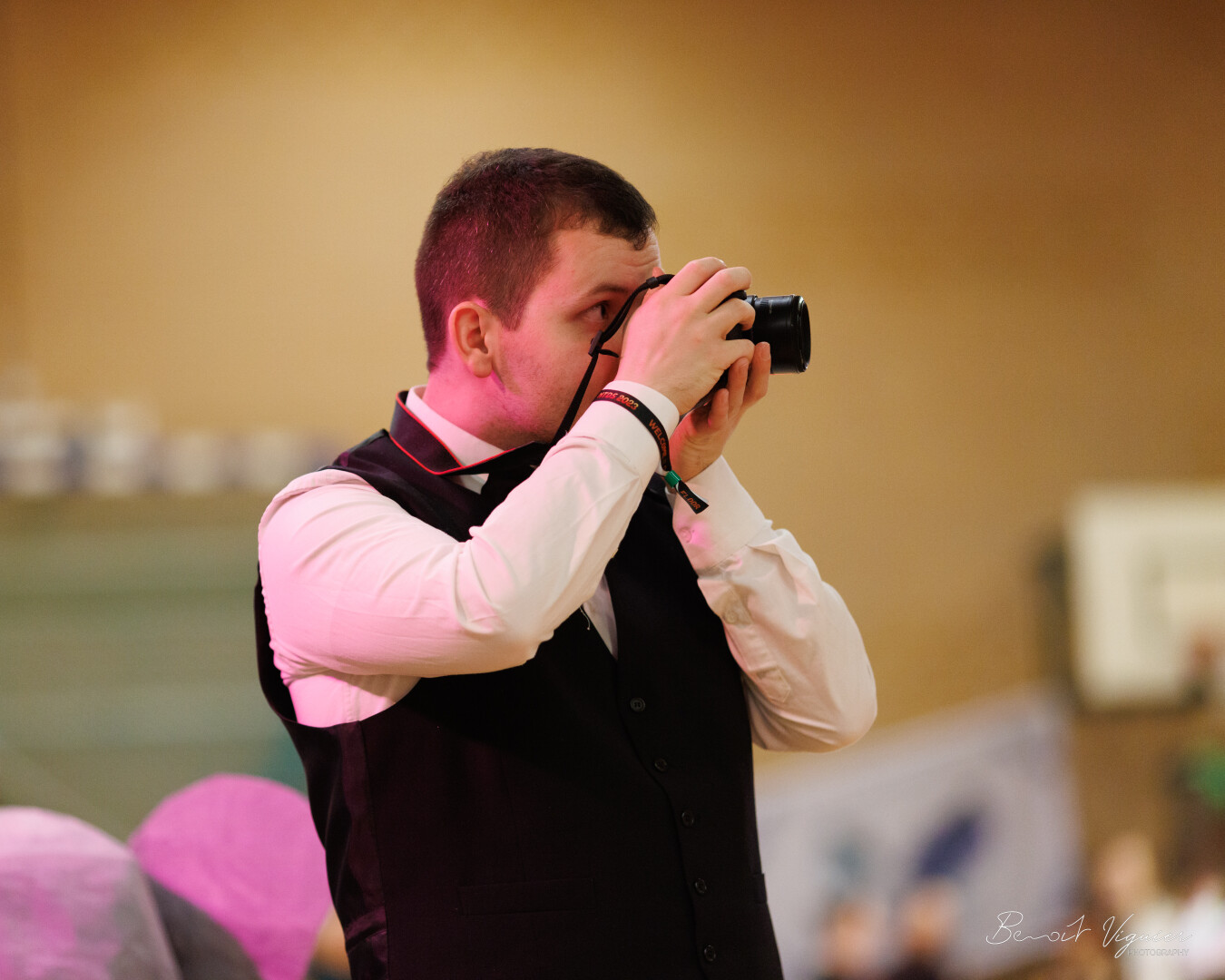
Aart and his small EF 50mm f/1.8.
What settings should I use?
It really depends.
There is no good answer. The shutter speed should be fast enough to freeze the movement, but slow enough to let enough light in. It also depends of the resolution of your sensor. If you have a high megapixel body, then a higher shutter speed is needed in order to freeze the movement.
As a rule of thumb:
- For a 24 Megapixel body, I shot mostly above 1/400s (my old EOS m50)
- For a 30 Megapixel body, I shot mostly above 1/640s (my old EOS R)
- For a 45 Megapixel body, I shoot mostly above 1/800s and 1/1000s for Quickstep (in the Open)
I usually shoot with my aperture wide open to let the maximum amount of light in. So f/1.8 or f/1.4 depending of my lenses. However this has its own drawbacks: the depth of field (part of the space that is sharp) is very thin. Should a couple get very close, I will only be able to get the lead or the follow in focus, but not both of them. This is not exact science, it is mostly a stylistic choice. Some photographers will close down their aperture a bit, e.g., f/2.2 or f/3.5 in order to get more of the couple in focus.
Then at last, we compensate the exposure with the ISO. It is not uncommon to shoot around ISO 3200 on Full Frame, or ISO 1600 on crop sensors. In very difficult conditions, I may even go up to 12 800 ISO.
As for the White Balance, while leaving it in Auto is a reasonable option (especially with recent cameras), the color of the lights are often changing all over the floor. For this reason it is better to set it once to a natural look so that your colors are uniform across your shooting session. This will also simplify significantly the editing later.
Finally, set the Auto Focus mode to SERVO instead of ONE SHOT. This ensures that when aquiring focus, the camera keeps focusing on the moving subject. The frame rate may get slower, but it is better to have 3 pictures in focus rather than 8 out of focus because the dancers moved forward.
Any more tips & tricks?
Sure!
In general.
- Do not run (thx Marty for that one). If you are not in time for the shot you want, so be it!
- Try to anticipate which figures the couples will be dancing, look around.
- Do not only focus on the couples you know.
- It is fine to walk around the floor, but do so calmly.
- Be mindful of the judges, try to pass behind them.
- Be mindful of the other photographers when walking around, do not randomly stand in front of them.
- At official events, do not walk on the floor. During XTDS events, it is fine to be at the same level of the judges, but not forward.
- Between heats, quickly look through the pictures you took and delete already the very bad ones (out of focus, obvious wrong framing...) This may not be much, but in the end it may be an additional 500 pictures you do not need to go through when editing.
- Smile at the couples to help them relax.
- Try to focus on lower level dancers in the early rounds, as they might not be dancing the next ones.
In Standard:
- In Viennese Waltz, it is better to be at the beginning of a long side.
- In Quickstep, it is better to be at the end of a long side.
- Couples tend to do line figures in the middle-2/3 of the floor and in the corners.
In Latin:
- Try to hit the shutter on the 2nd beat in the Rumba and Cha-cha-cha.
- Close up shots in rumba can create a lot of emotions.
- In the Paso Doble, chose a couple for the Highlight, pick that couple and get the highlight. Do not try to shoot multiple couples, they are rarely sticking the pose long enough.
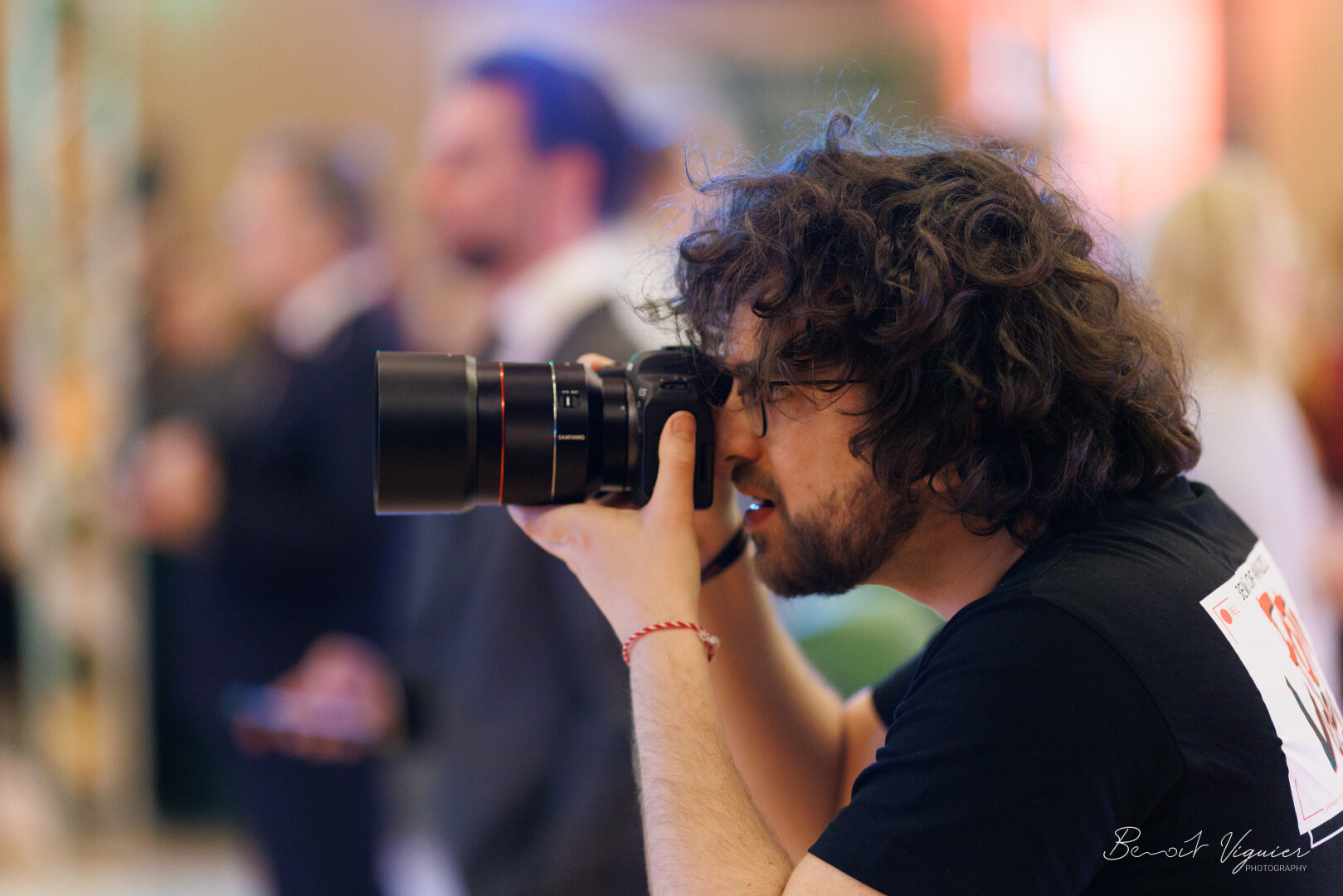
Levi with my Samyang 85mm f/1.4.
Oops! I took 5000+ pictures, what should I do?
Good Luck!
I would suggest a 2 step editing process:
- Culling -- This is the selection of the pictures you will edit.
- Editing -- This is usually correcting exposure, white balance, cropping, changing colors to match your style etc.
For the editing part, there are basically 2 lead software in the field:
- Adobe Lightroom & Photoshop
- Capture One.
For the culling, I would consider the 3 following software:
- Lightroom (but you will need to import and create the previews to check sharpness)
- Photo Mechanics
- FastRawiewer (thank you Levi for showing me that one)
In my case I use FastRawViewer for the culling because it is cheap (one time ~30€) and very fast, and I then import my non-rejected pictures into Lightroom.
Also do not be affraid to reject pictures, it is not uncommon to trash 75% of your shots. With experience the rejection rate will decrease, leading to higher quality overall. Personally, I believe it is better not have pictures of a specific couple rather than bad ones. It will also set the tone of your reputation: “I may not have a good picture from that photographer, but I know that when I get one, it will be good.”
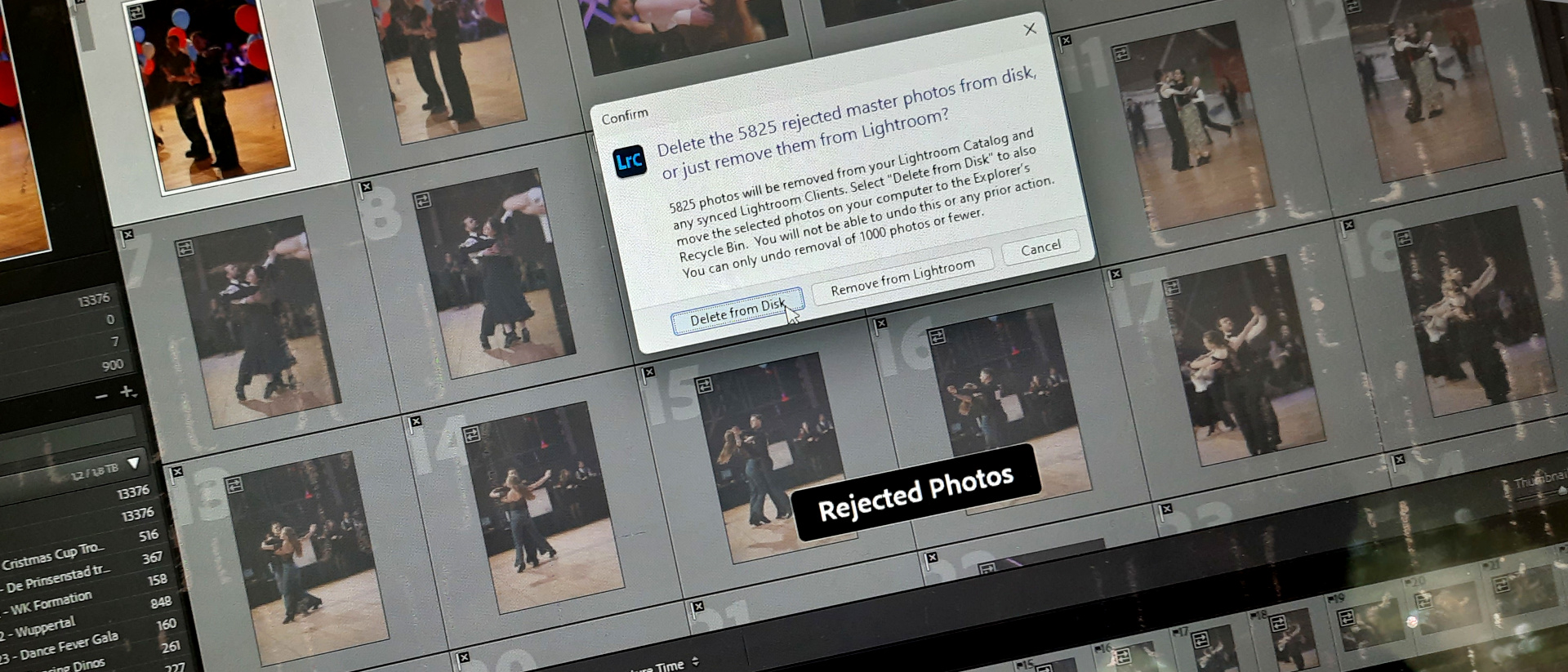
Deleting rejected pictures in Lightroom with the shortcut CTRL + Backspace